

How RTP and Volatility Affect Online Casino Slots
When you explore the extensive library of games at any online casino, two fundamental mathematical concepts determine your long-term experience: Return to Player and variance. A reference like best online casinos for real money can provide another useful angle on the subject. Players researching these mechanics often review tools like for detailed breakdowns of software specifications. Every single spin executed within a virtual casino relies on underlying formulas that dictate payout behavior across millions of individual rounds.
What Defines Return
Return to Player, commonly abbreviated as RTP, represents the theoretical proportion of wagered funds that a specific machine will pay back over an extended period. If a title features a 96 percent return rate, the statistical expectation points toward that proportion returning to players collectively. However, this metric operates on a massive sample size rather than a single evening of entertainment at the casino.
• Return to Player, commonly abbreviated as RTP, represents the theoretical proportion of wagered funds that a specific machine will pay back over an extended period
• If a title features a 96 percent return rate, the statistical expectation points toward that proportion returning to players collectively
• However, this metric operates on a massive sample size rather than a single evening of entertainment at the casino
• High volatility machines demand greater patience, presenting long dry spells punctuated by rare, substantial payouts that can dramatically alter a bankroll inside the casino
• A high-return, low-volatility machine suits participants seeking prolonged entertainment without severe bankroll swings
• Conversely, high-risk alternatives appeal to individuals comfortable with steep fluctuations in pursuit of larger peak multipliers available at the casino
• Recognizing the mathematical framework behind slots prevents unrealistic expectations regarding short-term profit
• Because random number generators dictate every outcome, no tactical adjustment can alter the underlying house edge built into every game hosted by a casino
Volatility measures the frequency and magnitude of payouts during a session. Low volatility options hand out frequent, modest rewards, keeping balances relatively stable. High volatility machines demand greater patience, presenting long dry spells punctuated by rare, substantial payouts that can dramatically alter a bankroll inside the casino.
Why Combining Matters
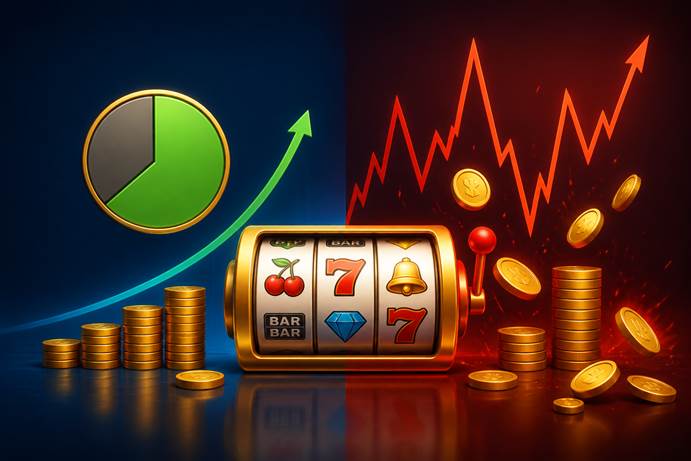
Combining these two core attributes yields widely different user experiences. A high-return, low-volatility machine suits participants seeking prolonged entertainment without severe bankroll swings. Conversely, high-risk alternatives appeal to individuals comfortable with steep fluctuations in pursuit of larger peak multipliers available at the casino.
|
Area |
What to know |
|
Context |
Return to Player, commonly abbreviated as RTP, represents the theoretical proportion of wagered funds that a specific machine will pay back over an extended period. |
|
Consideration |
Volatility measures the frequency and magnitude of payouts during a session. |
|
Practical takeaway |
Combining these two core attributes yields widely different user experiences. |
Recognizing the mathematical framework behind slots prevents unrealistic expectations regarding short-term profit. Because random number generators dictate every outcome, no tactical adjustment can alter the underlying house edge built into every game hosted by a casino.
Balancing Treating and Slot Design
Treating slots as a form of paid leisure preserves the enjoyment factor while preventing the frustration born from misunderstood math. Ultimately, keeping these statistical realities in mind ensures that every hour spent exploring digital reels at a casino remains an informed and controlled recreational pursuit.